Master
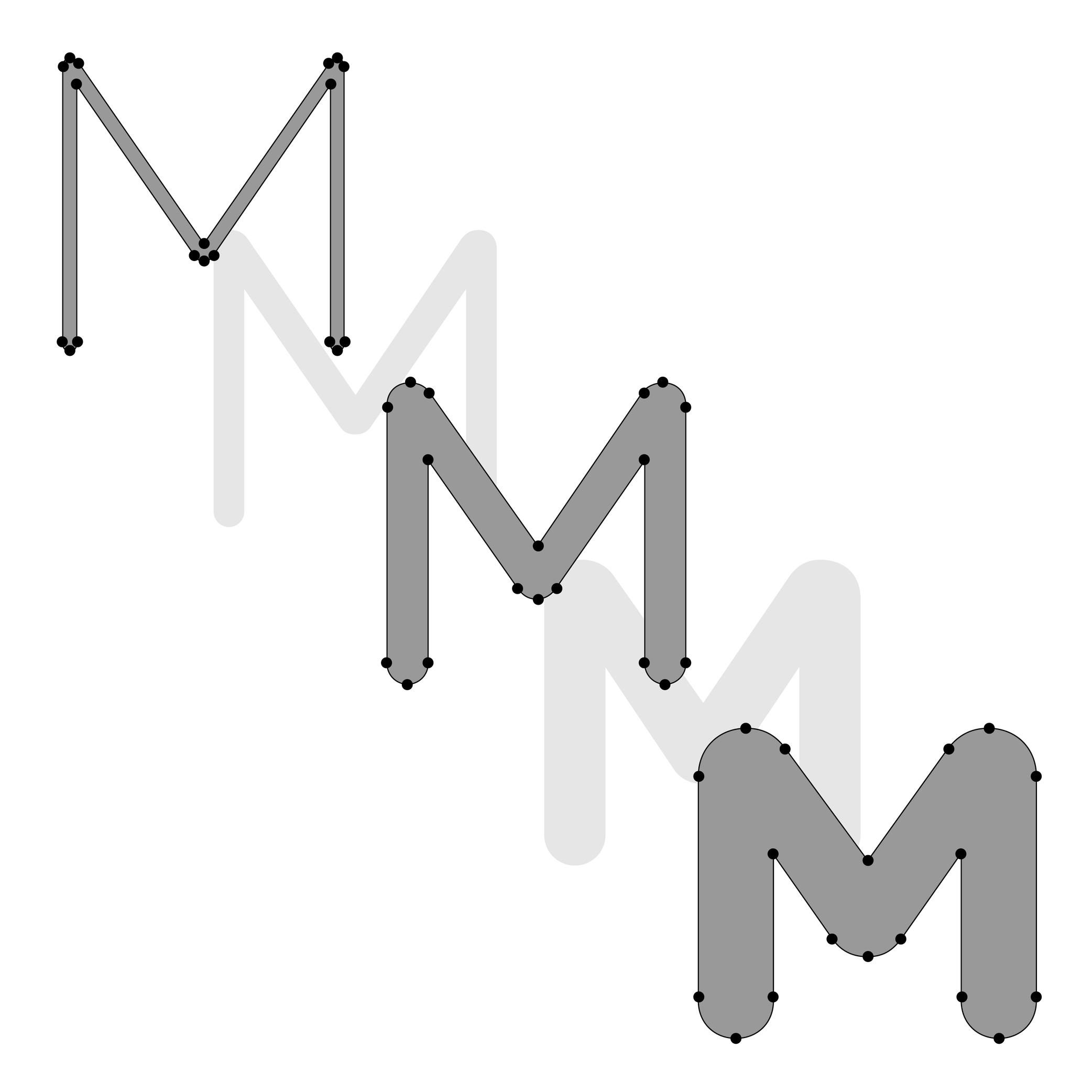
Illustration: Lisa Huang. Typeface in use: Knowledge Rounded, designed by Lisa Huang, 2024.
In digital type design, a master is a fully drawn style of a typeface (e.g., Regular, Bold, Regular Condensed) that defines a reference point in its design space (the area in which a typeface can change in terms of weight, width, and so on, such as going from Regular to Bold).
Masters are used to generate intermediate instances through interpolations. For an interpolation to work, masters must be compatible with each other (same contour structure, point order, components, etc.).
In general, a master means it is a style—in or of a typeface—with editable outlines in a typeface file, as opposed to interpolated instances which are generated intermediaries, and therefore are not directly editable.
NOTE
The terms “source” and “master” are terms that are often mixed up.
A source file (with.glyphs, .ufo, .vfj format extensions) is a working file containing editable outlines and can contain one or more masters. It usually requires a font editor app to be opened and modified (e.g., GlyphsApp, Robofont, Fontlab).
The font format .ufo (for Unified Font Object) is compatible with most font editors. In that format, one master corresponds to one source.
FONT ENGINEERING HINT
In Variable Fonts, only one full master (the origin) is stored explicitly. Additional masters are stored as variation instructions data in the gvar (Glyph Variation) table. Intermediate masters (not the extremes of an axis) can also be defined, and generated. Intermediates are needed when simple linear interpolations between two extremes would result in undesired designs at some point. They add extra data to describe corrections along the axis, ensuring smoother or more controlled transitions. While they don’t store full outlines, including them still increases file size.