Postscript Format
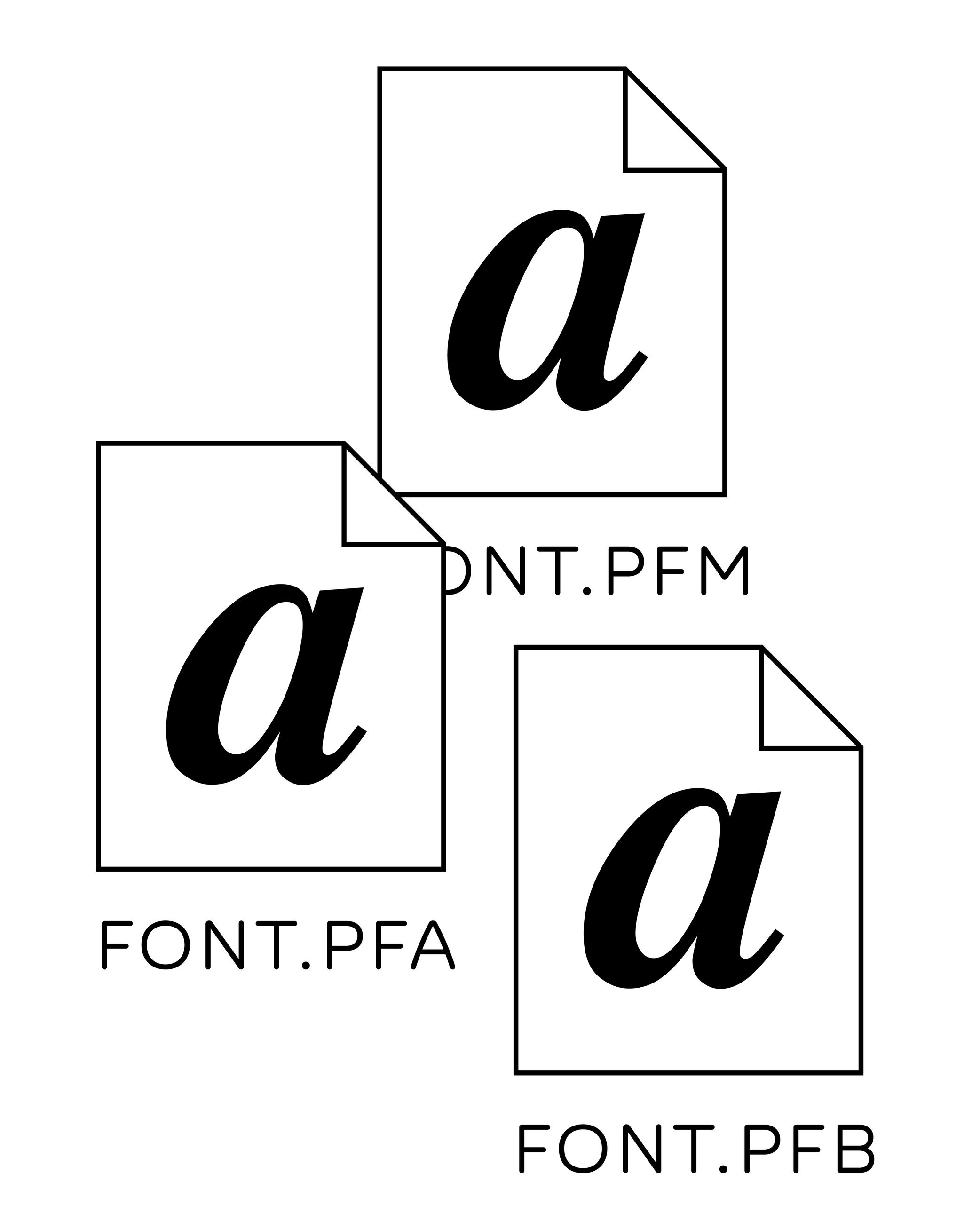
Illustration: Words of Type.
PostScript is a page description language (PDL) created by Adobe in 1982. It was specifically designed to describe the layout of a printed page: where text and images go, how fonts and graphics should be rendered, etc.
It enabled the rise of digital publishing (DTP, or Desktop Publishing) by allowing images and text to be printed by high-resolution laser printers.
Before PostScript, fonts were bitmap-based (made of pixels), and their quality varied depending on the size they are used at and the resolution of the printers. PostScript fonts introduced scalable outlines defined with cubic Bézier curves (digital vectors), which made it possible to render texts at any size with shapes that are faithful to the original design.
When Adobe released the PostScript Type 1 format, fonts required multiple files:
• one containing glyphs outlines and metrics;
• one for screen displays;
• and one for printers use.
All of these had to be installed together for the font to work.
CAUTION
Adobe officially ended support in their products for PostScript Type 1 fonts since 2023. They are also no longer supported by many modern operating systems, so transitioning to OpenType (.otf or .ttf) is essential for compatibility.
FONT ENGINEERING HINT
Modern OpenType fonts with PostScript outlines (.otf) no longer rely on multiple files. Instead, they store cubic Bézier outlines inside the CFF (Compact Font Format) table.
Notes
EXTENSIONS
.pfa
.pfb
.pfm