Hinting
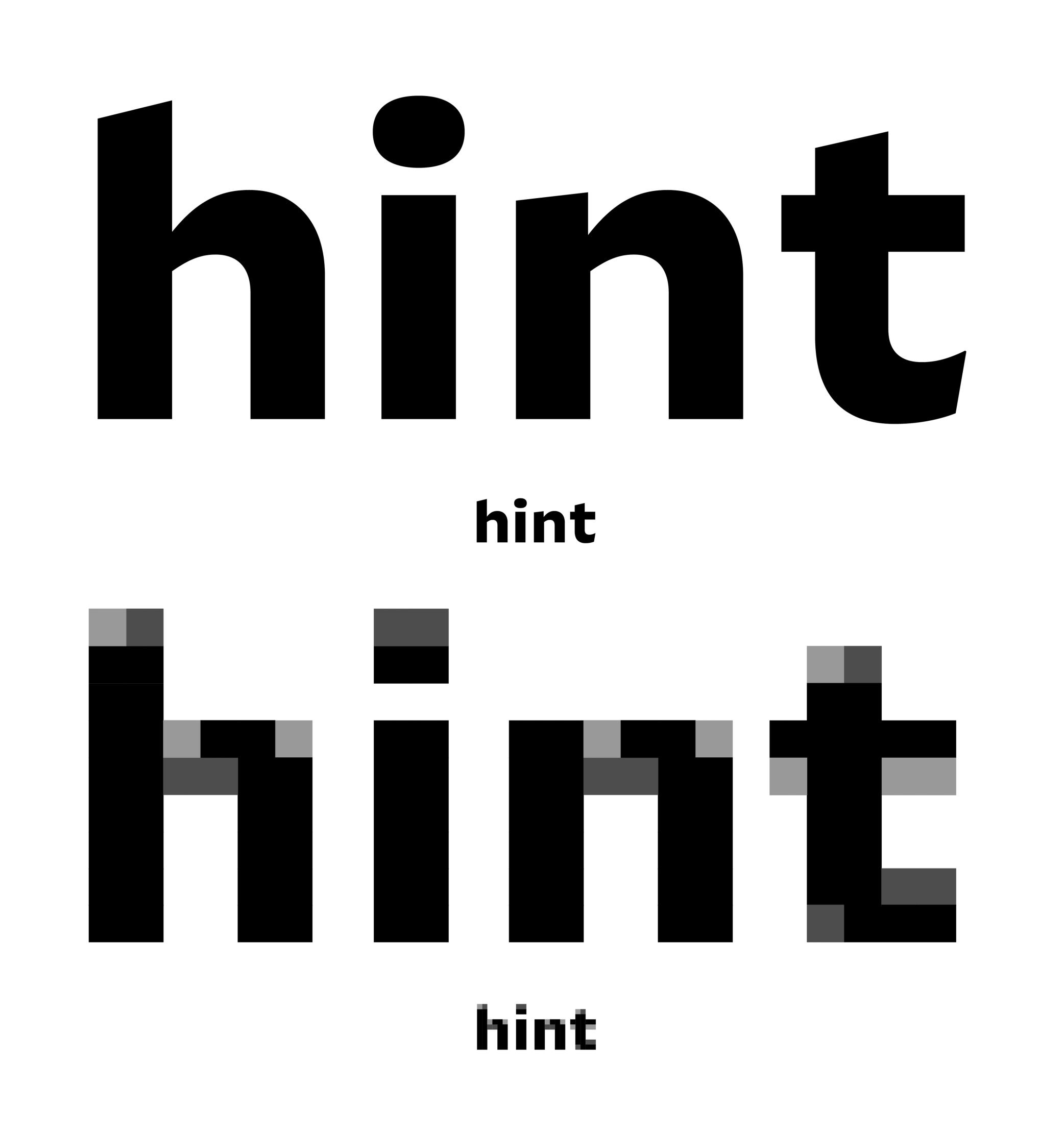
Sponsored by Frere-Jones Type . Typeface in use: Mallory MicroPlus , designed by Tobias Frere-Jones.
Hinting is the process of embedding instructions into a font file to optimize how it renders at small sizes or lower screen resolutions. These instructions help maintain legibility by aligning key parts of glyphs—such as strokes and spacing—to the pixel grid.
GOING FURTHER
A large part of hinting involves key font data like alignment zones, overshoot values (also known as blue zones), and stem thickness.
There are two methods of hinting:
• auto-hinting, which uses algorithms to generate these instructions automatically;
• manual hinting, which gives a more precise control over how each glyph aligns, but is time-consuming.
Hinting also differs according to the type of outline:
• Truetype hinting (used in .ttf files), which is point-based. It adjusts individual points to align with the pixel grid;
• Postcript hinting (used in .otf files), which is stem-based. It aligns vertical and horizontal strokes to the pixel grid.
SUPPORT
Rendering support also varies:
• Windows and Android interpret TrueType hinting;
• Adobe apps interpret PostScript hinting;
• macOS and iOS native apps ignore hinting altogether.
Therefore, .ttf fonts are generally better for the web and office environments, while .otf fonts are preferred in professional publishing and design workflows using Adobe tools or PostScript printers.
FONT ENGINEERING ADVICE
TrueType hinting instructions are stored in dedicated tables such as glyf, fpgm, prep, cvt , and gasp. While all PS hinting instruction are stored in the CFF table.